Anastasia Maximova – Botanical Artist | Educator | Environmental Communicator
Beyond Biodiversity (artwork Series by anastasia Maximova) – City of Darwin Lightbox Exhibition 2025

City of Darwin Lightbox Exhibitions
City of Darwin Lightbox Exhibitions aim to showcase and illuminate local arts in the public realm, elevating Darwin’s creative community and contributing to the pedestrian experience.
For more information go to the website, call, or send us an email.
Website: http://www.darwin.nt.gov.au
Email: arts@darwin.nt.gov.au
Phone: 8930 0300
Beyond Biodiversity – Artwork Series
The Beyond Biodiversity – Artwork Series is a creative initiative dedicated to showcasing the native plant species and ecosystems of the Darwin region through contemporary botanical art. This exhibition aims to raise public awareness about biodiversity conservation and environmental sustainability by visually exploring the intricate beauty, fragility, and uniqueness of Top End flora.
Botanical Artist Info
Anastasia Maksimova is an award-winning botanical artist, educator, and researcher with a PhD in scientific environmental communication through visual arts. Her work celebrates the unique nature of the Top End and advocates for botanical art and sustainable development.
Red-Flowering Kurrajong
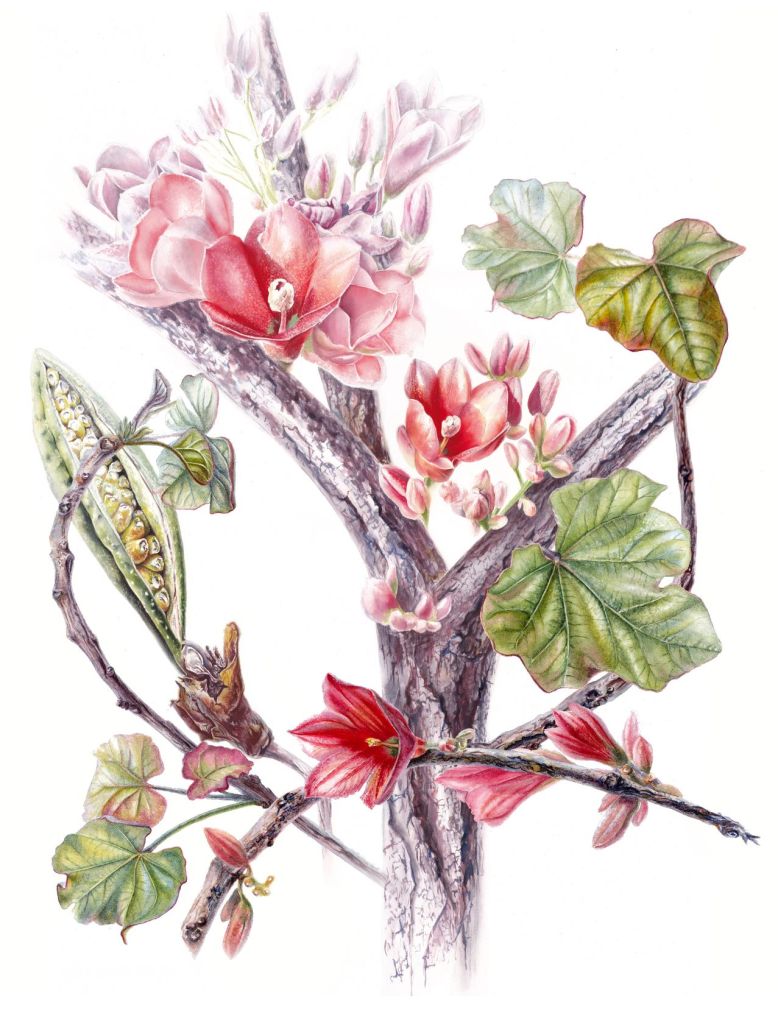
Red-Flowering Kurrajong
Brachychiton megaphyllus
The Red-Flowering Kurrajong Brachychiton megaphyllus is the floral emblem of Darwin.It reflects the vivid contrast of life in the Top End, mirroring its rhythm; in the Wet season, the tree is covered with large, curved leaves, while during Dry season its bare branches are draped in scarlet, bell-shaped flowers. It almost seems they ‘ring’ telling a melody about the changing seasons.
For First Nations people, the Kurrajong is a vital resource. Its seeds are roasted and eaten, and the bark fibres are used for weaving, ropes and fishing gear.
Ecologically, the Kurrajong makes a key contribution in adapting to arid conditions, retaining moisture, and providing a habitat for insects and birds. I see the Kurrajong as a symbol of nature’s might, splendour, and eternal renewal cycle.
Watercolour & Digital Design
© Anastasia Maximova 2025. All Rights Reserved
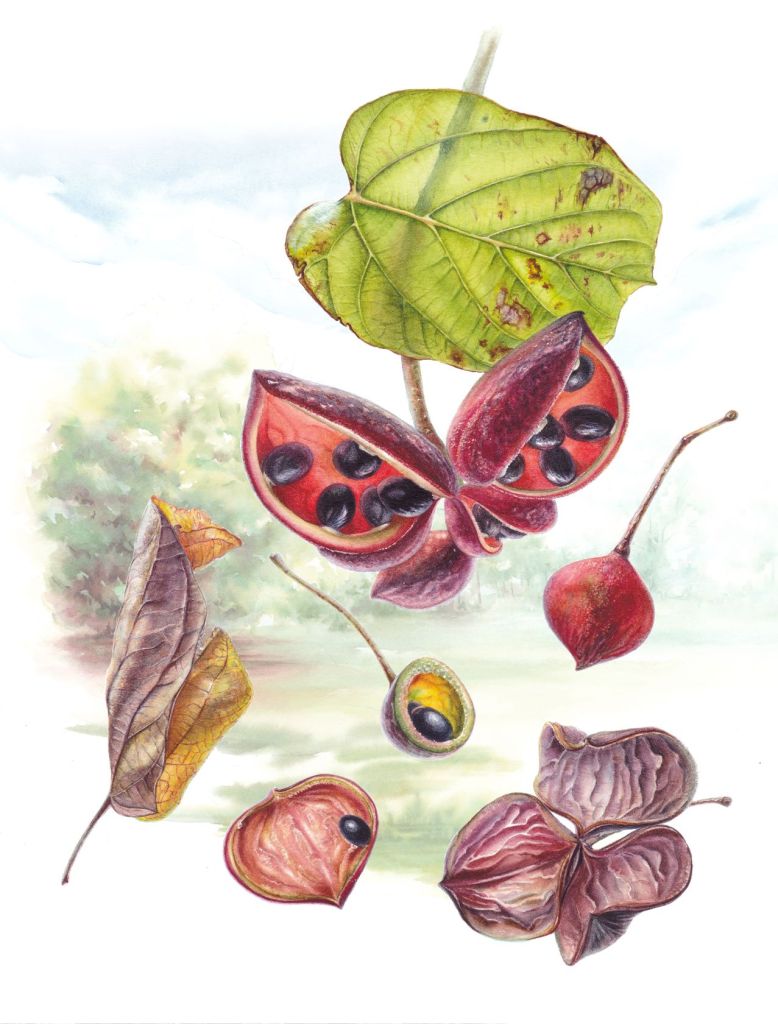
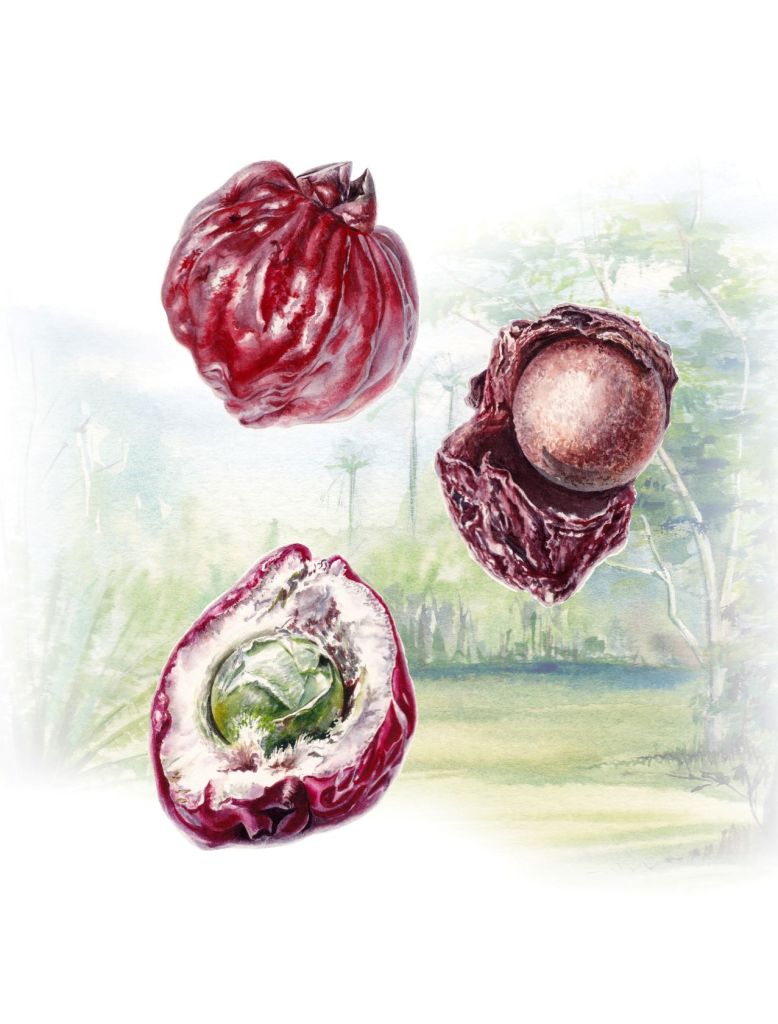
Peanut tree
Peanut Tree
Sterculia quadrifida
This cyclone-resistant tree blooms with delicate white flowers at the start of the Wet Season, bringing lightness and freshness to the landscape. As its bright red fruits ripen, the surrounding environment transforms, standing out vividly against the terrain and attracting native insects and birds.
This tree is a valuable food source for First Nations people. Its seeds are not only highly nutritious but also have a rich, peanut-like flavour. The leaf juice is known for its medicinal properties, while the bark is used for crafting fishing gear and weaving.
This artwork invites the viewer to reflect on the beauty of life; from a tiny seed sprouting into a new shoot, to a withered leaf carried away by the wind. Each stage holds its own cosmic significance in this endless cycle: humble flowers transform into vibrant, succulent fruits, only to complete their journey and make way for a new beginning.
Watercolour & Digital Design
© Anastasia Maximova 2025. All Rights Reserved
Spotted Mangrove
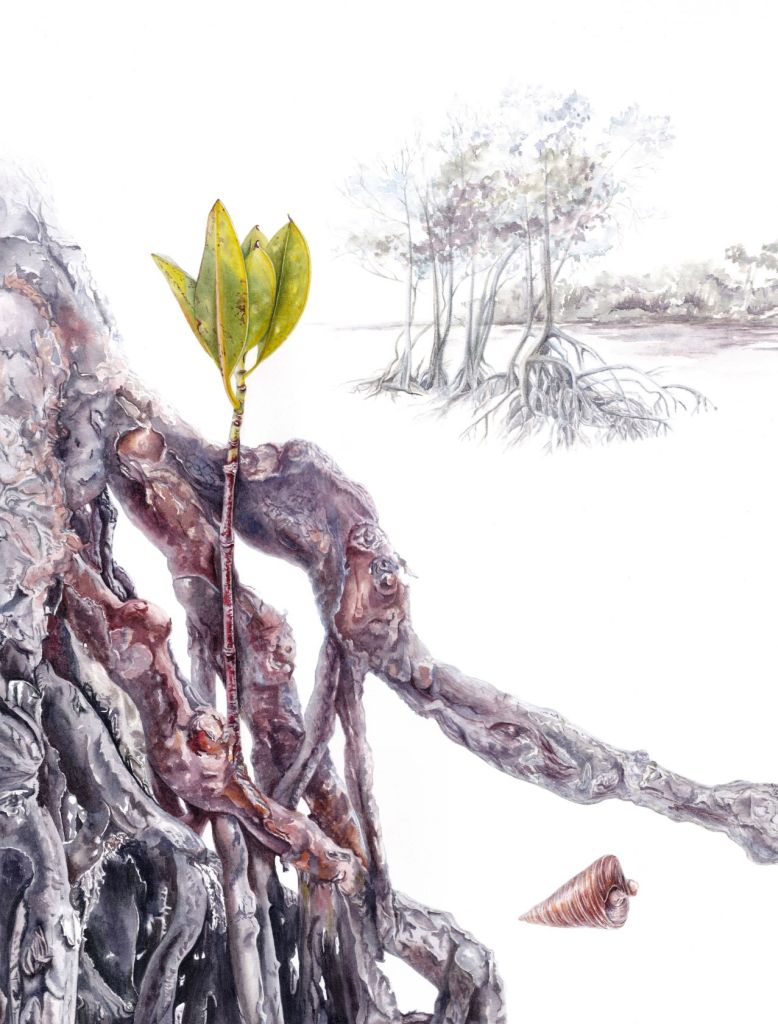
Spotted Mangrove
Rhizophora stylosa
Mangroves represent a unique ecosystem capable of surviving in the harsh coastal conditions in Northern Australia, including saline waters, oxygen-poor soils, radiant sun, and devastating cyclones. Their extensive root systems secure shorelines, protect against erosion, and create favourable habitats for numerous plant and animal species, supporting coastal biodiversity.
For First Nations people, mangroves continue to provide food and support traditional hunting and gathering practices. Their wood is used for making fishing gear, simple tools, and traditional medicine.
This visual story reflects the contrast between the rough texture of the roots and the vibrant green leaves, symbolising life’s strength and fragility. The Telescope Snail Telescopium telescopium, a traditional bush tucker and ecological biomonitor, highlights the interconnectedness within this ecosystem.
Watercolour & Digital Design
© Anastasia Maximova 2025. All Rights Reserved
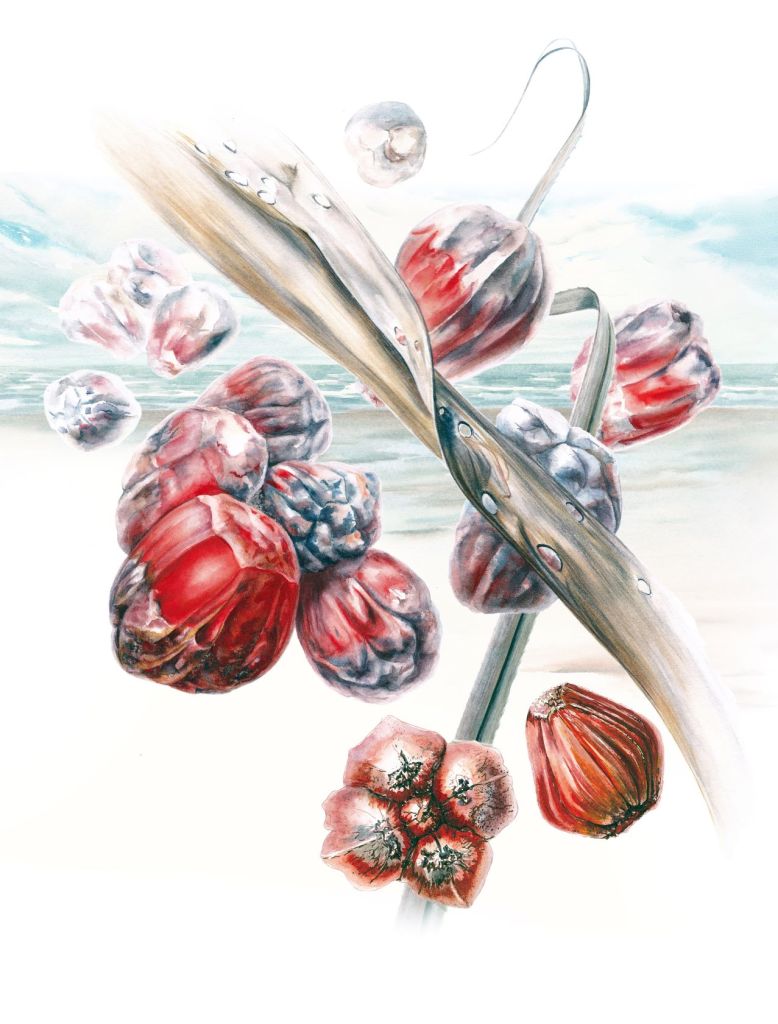
Screw Palm
Screw Palm
Pandanus spiralis
This endemic and iconic Australian plant is a characteristic of the Northern Territory ecosystem and shapes the coastal landscape. Thriving along the edges of coastal dunes, it acts like a natural weathervane, revealing the direction and intensity of sea winds.
For First Nation Australians, this plant holds great cultural significance and practical use. The Pandanus fruits are consumed as food, its juice is valued for its healing properties, and the leaves and roots are used for weaving ropes, artworks and crafting household items.
The inspiration for this work came during the Dry Season when its vibrant, deep-orange fruits ripen. The wind, an invisible force of nature, lifts and drops them like meteorites, shattering upon impact into intricate geometric forms.
Watercolour & Digital Design
© Anastasia Maximova 2025. All Rights Reserved
Elephant Ear Wattle
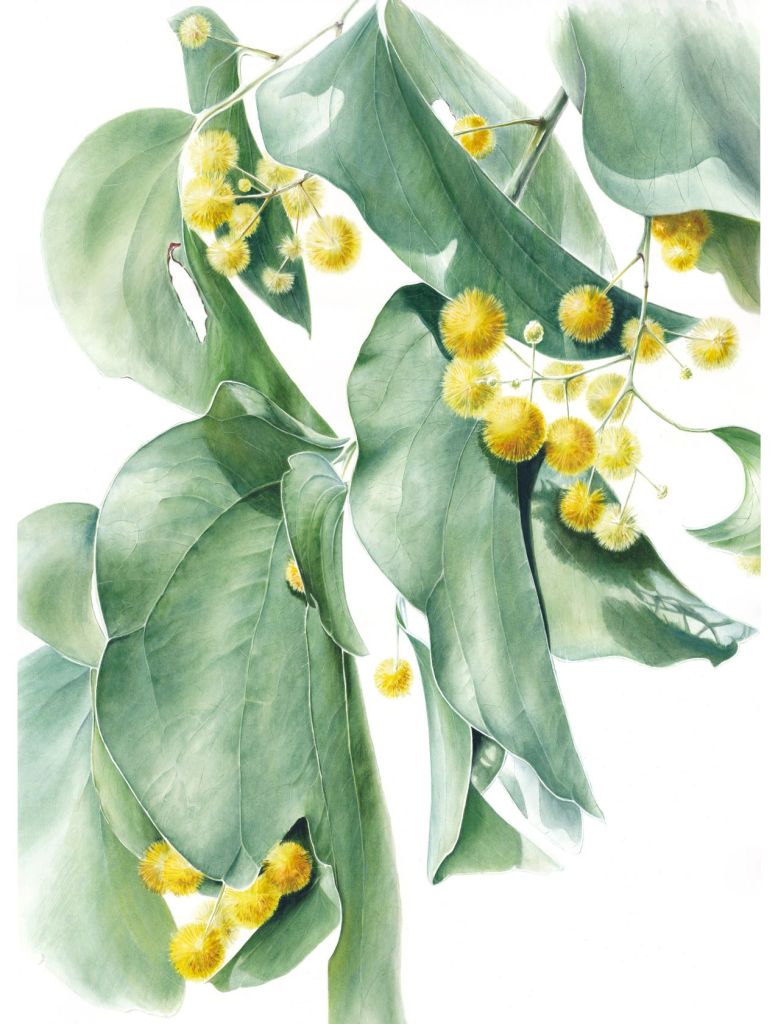
Elephant Ear Wattle
Acacia dunnii
This magnificent and resilient tree thrives in various landscapes, from sandy plains to rugged, rocky hills. Its mesmerizing silvery-blue foliage, contrasts with the delicate, lemon-yellow, feathery flower clusters.
This plant is an essential and versatile resource for First Nations people. Its seeds are consumed as food, the leaves are used to infuse dishes with a subtle aroma, and the bark has medicinal applications. The wood is crafted into tools and its fibres woven into ropes and nets. The Elephant Ear Wattle is also a source of natural alluring dyes, ranging from vibrant yellows to deep golden browns.
I am especially fascinated by the geometric perfection of its phyllodes, (modified leaves stems that look like leaves), spiraling along the branches. The golden inflorescences (arrangement of the flowers) further enhance its charm, highlighting the contrast between the softness of the blossoms and the refined elegance of its canopy.
Watercolour & Digital Design
© Anastasia Maximova 2025. All Rights Reserved
Red Bush Apple
Red Bush Apple
Syzygium suborbiculare
This tree is fundamental to the ecosystem of Northern Australia, providing shade and nectar for variety of pollinators. Its large, creamy flowers gradually develop into vibrant ruby-red fruits, attracting variety of creatures, including birds and small mammals and supporting the region’s biodiversity.
For First Nations people, the Red Bush Apple has great significance. Its fruits have long been consumed as food, its wood used as fuel and the leaves and fruits have medicinal applications.
The striking appearance of the Red Bush Apple inspires me. The plant’s smooth, glossy leaves reflect the cool sky in their highlights, providing a strong contrast to the bright, ridged, and deeply textured fruits. I am especially attracted by its subsequent transformation; after falling to the ground, the fruits split open, revealing a snow white core that gently cradles the developing seeds.
Watercolour & Digital Design
© Anastasia Maximova 2025. All Rights Reserved
Swamp Bloodwood
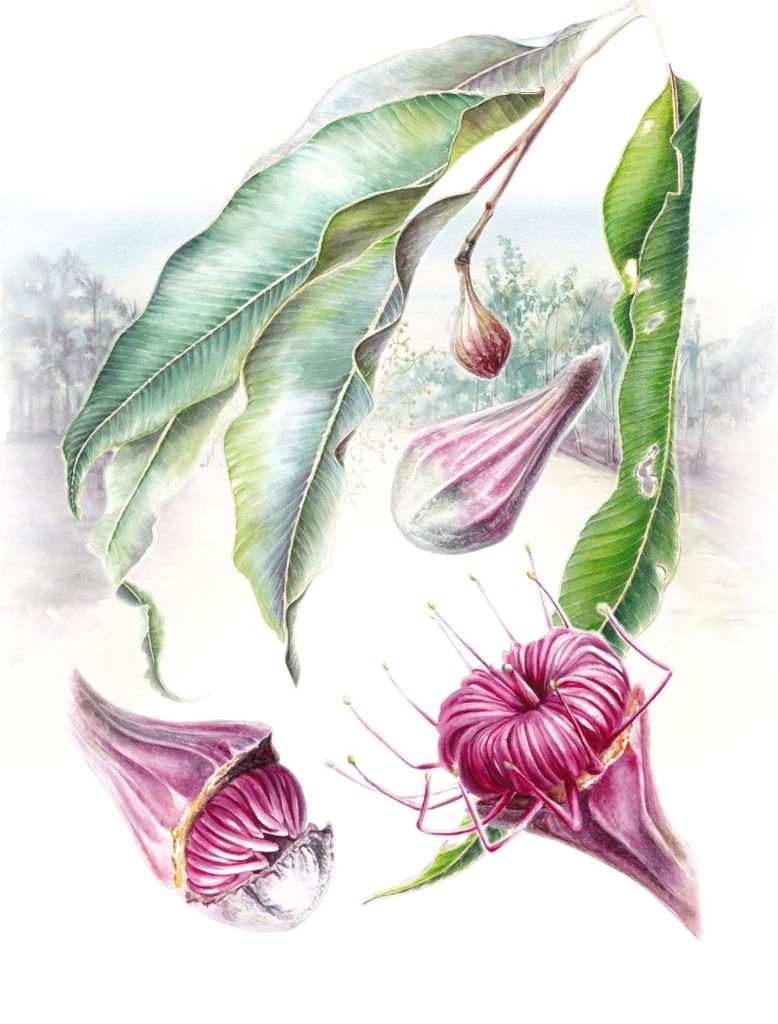
Swamp Bloodwood
Corymbia ptychocarpa
This graceful tree, with its cascading form and curving leaves, resembles soft waves and not only compliments the landscape, but also plays a crucial role in the ecosystems of Northern Australia. It’s a magnet for insects and birds during its flowering season. Resilient to cyclones, it thrives in the harshest conditions, demonstrating an extraordinary ability to adapt.
This plant has a practical significance and great cultural value for First Nations people. Its dense, fibrous wood has long been used for fire-starting. Its leaves, capable of producing melodical sounds in the hands of a skilled person, are integral to musical traditions, embodying the deep creative connection between people and nature.
I am enchanted by this magnificent tree. I sought to capture the magical moment when the buds unfurl, revealing extraordinary blossoms, a vivid contrast to the sculptural, ribbed forms of its woody fruit. I find it a fascinating interaction between fluidity and structure.
Watercolour & Digital Design
© Anastasia Maximova 2025. All Rights Reserved
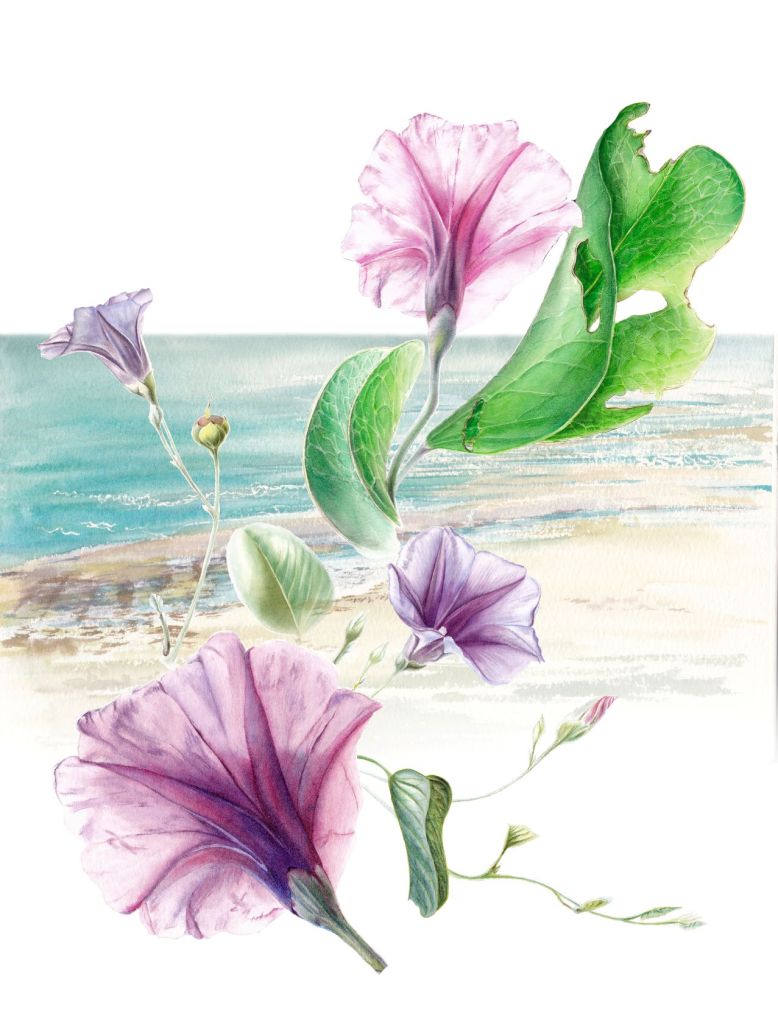
Morning Glory
Morning Glory
Ipomea pes-caprae
Ipomoea pes-caprae, known as Morning Glory, unveils its ethereal and enchanting flowers on the boundary between land and sea. Each morning, its silken petals in hues of sunrise pink open toward the new day as if reminding us of the power of new beginnings. It fears neither salty winds nor heavy rains; its anchoring roots solidly bind the sand, preserving dunes and providing shelter for insects and small animals.
This plant is a valuable resource for First Nations people; its roots can serve as food, while its leaves and flowers are used for medicinal purposes.
Morning Glory reminds us that every sunrise is a chance for life. But for many species, that dawn may never come if we do not maintain the fragile balance of nature.
Watercolour & Digital Design
© Anastasia Maximova 2025. All Rights Reserved
Waterlilies
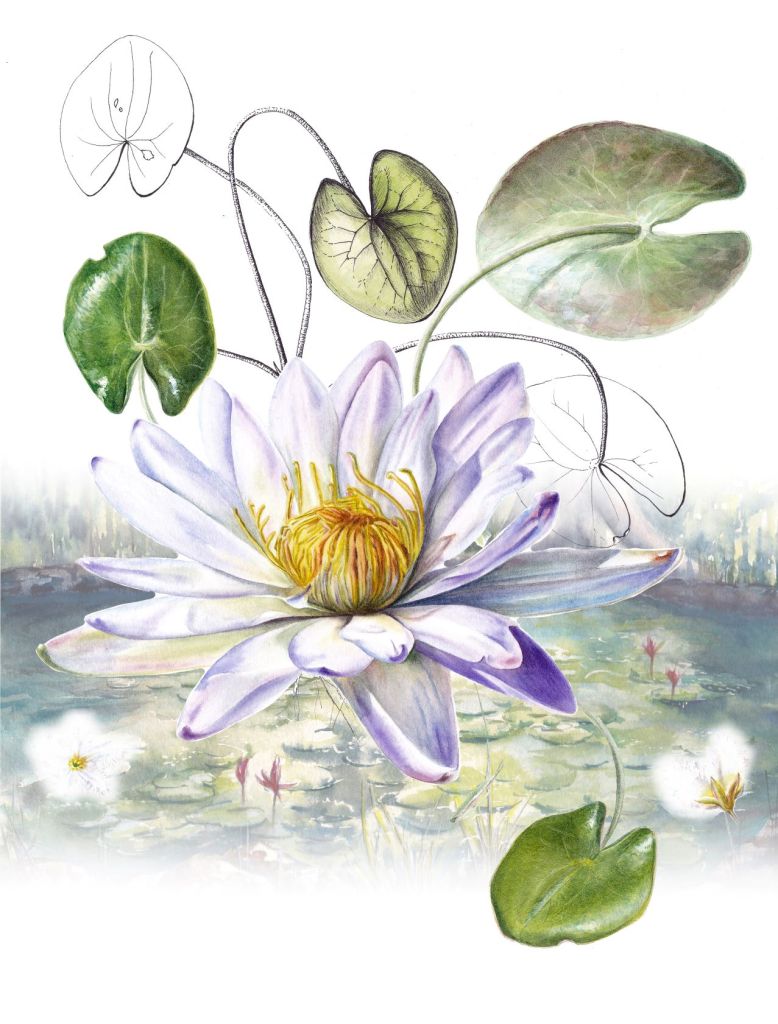
Waterlilies
Nymphaea violacea, Nymphoides indica
Nymphaea violacea and Nymphoides indica play a vital role in the ecosystems of the Northern Territory. Aquatic plants help maintain water quality, provide habitat and shelter for various organisms, and contribute to nutrient cycling.
For First Nations people, these plants have practical function and traditionally are used in medicine and food.
The enchanting flowers mesmerise with their grandeur and radiance. I can observe the intricate details endlessly and feel that they reveal new inspiration in every petal.
Watercolour & Digital Design
© Anastasia Maximova 2025. All Rights Reserved
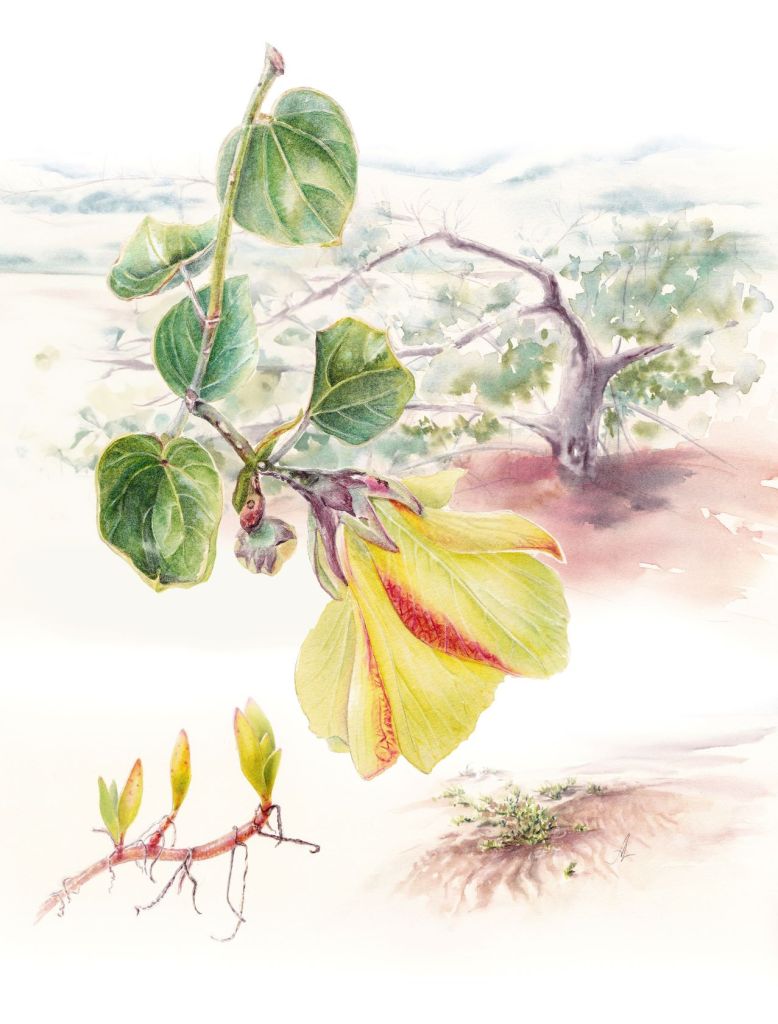
Sea Hibiscus and Sea Purslane
Sea Hibiscus and Sea Purslane
Hibiscus tiliaceus, Sesuvium portulacastrum
These two remarkable plants play essential roles in Northen Australia’s coastal ecosystems. Hibiscus tiliaceus, with its vibrant flowers ranging from sunny yellow to soft lemon, blooms year-round, beautifully decorating and reinforcing the shore. Like unseen protectors, its roots stabilise the dunes and purify the water, supporting the ecosystem.
For First Nations people, this tree is an embodiment of strength: its wood lights fire, branches can become spears, and its bark is used for weaving. The flowers, leaves, and roots are edible, and the sap, like a healing elixir, is used for medicinal purposes.
No less important is Sesuvium portulacastrum, a plant that withstands severe storms and extreme heat. It confidently spreads across the shore, helping to secure mounds of sand and ornaments the coast with succulent olive-hued leaves and delicate lilac-pink star-shaped flowers. Together, these plants
symbolise resilience and life along the shore, seamlessly integrating into the ecosystem and cultural traditions.
Watercolour & Digital Design
© Anastasia Maximova 2025. All Rights Reserved
 LetPlantsBe